
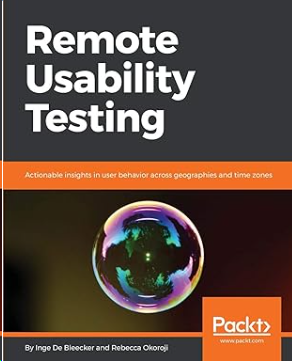
Remote Usability Testing
Actionable insights in user behavior across geographies and time zones
One of the “best usability books of 2020“
One of the “top 6 how-to books for UX research“
The UXPA “definitive guide” on the subject.
Our book a.k.a. “the book”
Usability testing is a subdiscipline of User Experience. Its goal is to ensure that a given product is easy to use and the user’s experience with the product is intuitive and satisfying. Usability studies are conducted with study participants who are representative of the target users to gather feedback on a user interface. The feedback is then used to refine and improve the user interface.
Remote studies involve fewer logistics, allow participation regardless of location and are quicker and cheaper to execute compared to in person studies, while delivering valuable insights. The users are not inhibited by being in a new environment under observation; they can act naturally in their familiar environment. Remote unmoderated studies additionally have the advantage of being independent of time zones.
“The book” will teach you how to conduct qualitative remote usability studies, in particular remote moderated and unmoderated studies. Each chapter provides actionable tips on how to use each methodology and how to compensate for the specific nature of each methodology. “The book” also provides material to help with planning and executing each study type.
Who this book is for
This book is for user experience (UX) professionals familiar with traditional in-person usability testing methodologies, or for UX designers with no prior exposure to user research and usability testing.
Customer experience professionals or product managers who want to understand remote usability testing will also find this book useful. No knowledge of remote usability testing is needed.
The assets
If you have read “the book”, you’ll know that we offer the assets we refer to for download … and if you haven’t read it, we recommend you do.
Here are the resources we promised:

Kickoff Checklist
A structured list of tasks and requirements to get everyone aligned and ensure the study is set up correctly before it begins.

Recruitment Screener
A sample questionnaire used to identify and select participants who match the study’s target profile.

Discussion guide
A template with questions, and prompts to guide conversations with participants during moderated sessions.
Survey Script
Sample survey that collects personal data and guides participants through tasks without a moderator present.
Recorded Data Spreadsheet
A template for capturing notes, behaviors, and key observations during or after participant sessions.
Study Report
A synthesized document presenting findings, insights, and actionable recommendations based on the research.
The journey
Writing a book is a journey that begins with the first step …
First Contact
Initially, PACKT (a publishing company focused on information technology) approached us to write a book about UI/UX dos and don’ts, based on our work with the USERindex and our experience measuring user experiences. We responded that if they were looking for something like “Don’t Make Me Think” by Steve Krug or “Prioritizing Web Usability” by Jakob Nielsen (books that list general rules to follow and pitfalls to avoid to improve usability) we might not be the right authors. Several excellent books on that topic already existed, and we weren’t interested in reiterating what had already been well-covered. Instead, we proposed a book on a topic we felt was underappreciated: Remote Usability Testing. This was a couple of years before COVID, and at that time, many researchers still frowned at remote methods, believing that in-person testing was the only credible approach. By that time, we had collectively conducted around 500 remote studies and strongly disagreed with that sentiment.

Why not do something different?
Convincing the publisher to take on what they considered a “niche” book was challenging. Initially, they declined, so we decided to write the book independently. We were passionate about sharing our extensive experience and helping junior researchers avoid the mistakes we had made early on; and we also wanted to provide a comprehensive resource for anyone looking to understand Remote Usability Testing better. We collaborated on the outline, breaking down the topic into manageable and coherent chunks. And, about three months later, we sent the proposal of what we would like to write to PACKT. To our delight, they were excited about the idea, and we began the project in earnest.
Getting it done
PACKT also suggested including in-person testing, but we politely declined because remote testing was where we saw a significant gap in knowledge and documentation. They initially proposed a four-month writing timeline, followed by a month or two of refinement, with publication five to six months later. Argh! The pressure!
We divided the chapters between us and dedicated every spare minute to writing, or feeling guilty when we weren’t. Five months later, we delivered our final draft. The technical editor and copy editor then reviewed it, which involved some back-and-forth as they didn’t always appreciate how we infused our writing with our own sense of humor. However, a month later, everything was set, and the book was published in both paperback and Kindle formats.

The resumé
The journey was quite a ride, but the feedback we’ve received has been overwhelmingly positive. The book was listed as one of the best usability books of 2020 and one of the top six how-to books for UX research. The UXPA reviewed it and called it the ‘definitive book’ on the subject.
A significant undertaking; but one we’d repeat. In fact, we already are 