

Broken Conversations
A Practical Guide for Improving Chatbot UX
Why do users turn to chatbots?
- Because they value 24/7 availability.
- Because they don’t want to wait in line for a human agent.
- Because they have a simple question and assume the chatbot can handle it.
- Because they’re more comfortable typing than speaking in the required language.
- Because they prefer to interact with a machine rather than a human who they feel may judge them.
- Because they aren’t given the option to speak with a human (yes, they’ve figured that out).
- …
Whatever the reason users have to turn to chatbots, the outcome is often the same: they leave frustrated and, next time, avoid chatbots altogether, if possible. Why? Because many chatbot providers deliver lousy experiences. But we want to change that.
The chatbot UX mistakes we keep seeing
This is a collection of the most common issues we encounter repeatedly when user testing chatbots. When you see them, your reaction will be: “surely not … in this day and age”. But, sadly, our response is: “our thoughts exactly, but, yes, we’ve encountered these as recently as yesterday and with household brands”. Most of these do not apply to the general-purpose AI assistants available out there (like ChatGPT and the like) but those AI assistants are the ones shaping the user expectations which they then apply to the customer support chatbot.
This isn’t a lecture, it’s a leg up. We’ve seen companies make the same chatbot design mistakes again and again. Consider this series a checklist of what must be in place before launching yet another chatbot that risks reinforcing user skepticism and disappointment in your brand.
To this end, we’ve identified 10 categories that most of the issues we’ve encountered fall into:
Actionability
Ensures the chatbot clearly communicates the next steps and allows users to take meaningful action, whether it’s completing a task, accessing help, or moving forward in a process.

Content & Accuracy
Assesses whether the chatbot provides factually correct, coherent, and well-structured information. This includes clarity, formatting, verbosity, and the ability to gracefully handle unfamiliar or inappropriate requests.

Context-Awareness, Personalisation & Relevance
Measures the chatbot’s ability to maintain and adapt to context within a session, across sessions, or during escalation to a human agent. Includes personalization, dynamic suggestions, and how relevant and tailored the responses feel to the user.
Conversation Flow
Covers how naturally and logically the conversation progresses, including loops, misunderstood intents, awkward greetings, and abrupt endings. Also includes error recovery and system responsiveness: how smoothly the chatbot handles mistakes and how quickly it replies.

Hand-off to Human
Looks at how well the chatbot manages the transition from automated conversation to a human agent, including when the handoff is triggered, how clearly it is communicated, and what happens to the user during and after the transfer.

Integration
Focuses on how well the chatbot connects with external systems such as Ticketing systems, Order management systems, etc to provide real-time updates, personalized responses, or execute tasks within the conversation.
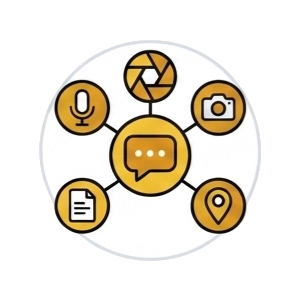
Multimodal Interaction
Looks at how well the chatbot handles inputs and outputs beyond text such as voice, images, document uploads, or structured data and whether these modes are used effectively.

Tone & Personality
Examines whether the chatbot’s language and tone align with the brand and show appropriate empathy. Also includes consistency in voice, style, and use of formal/informal address.

Trust & Data Safety
Concerns user confidence in how their data is handled by both the brand and third-party platforms. Includes transparency around data usage, privacy, and training data for AI models.

Usability & Customization
Covers the overall user experience, including chatbot discoverability, navigation, responsiveness, visual design, and input methods. Also includes customizable settings, chat history access, and how intuitive the interface feels.
If you’re asking yourself how we came up with these scenarios: we compiled over 100 issues we have encountered in our studies with chatbots and of course, our own personal use of chatbots. We clustered them, like good researchers do 😉and identified the patterns. The categories evolved from there.
Each example in the detailed category descriptions is based on a real-life experience. We anonymised and neutralised them, as our intention is not to single anyone out, but rather to provide a guide to help everyone improve their existing chatbots, create more pleasant user experiences, and avoid reinforcing or validating those prejudices against chatbots.
If this format does not work for you, then please let us know what would. Our goal is to stop these unnecessary, recurring issues once and for all and we’re more than happy to share the content with you in whatever format you are most likely to consume.