
Broken Conversations – A Practical Guide for Improving Chatbot UX

Tone and Personality
Examines whether the chatbot’s language and tone align with the brand and show appropriate empathy. Also includes consistency in voice, style, and use of formal/informal address.
Defining a chatbot’s tone and personality remains a controversial challenge in conversational design. While some argue for giving chatbots a distinct persona, user studies consistently show that a chatbot should be clearly identifiable as non-human rather than attempting to pass as a person. Ultimately, the key is ensuring that the level of friendliness is appropriate to the specific context of the interaction, balancing brand alignment with the user’s immediate needs.
The result of getting this balance wrong is always the same: a frustrated user.

Scenario 1: Inappropriate tone and address
A user chats with a chatbot and the tone of the chatbot is not per the user’s expectations. While some users appreciate an informal tone and the use of emojis to express friendliness, others find such casual interactions unprofessional or “childish,” particularly when dealing with serious or sensitive matters. In a language that supports the “T-V distinction” (that use different second-person pronouns (words for “you”) to express degrees of politeness, social distance, or familiarity), like German or French, the chatbot must choose between formal (“Sie / vous”) and informal (“du / tu”) address.

Scenario 2: Inconsistent tone or address
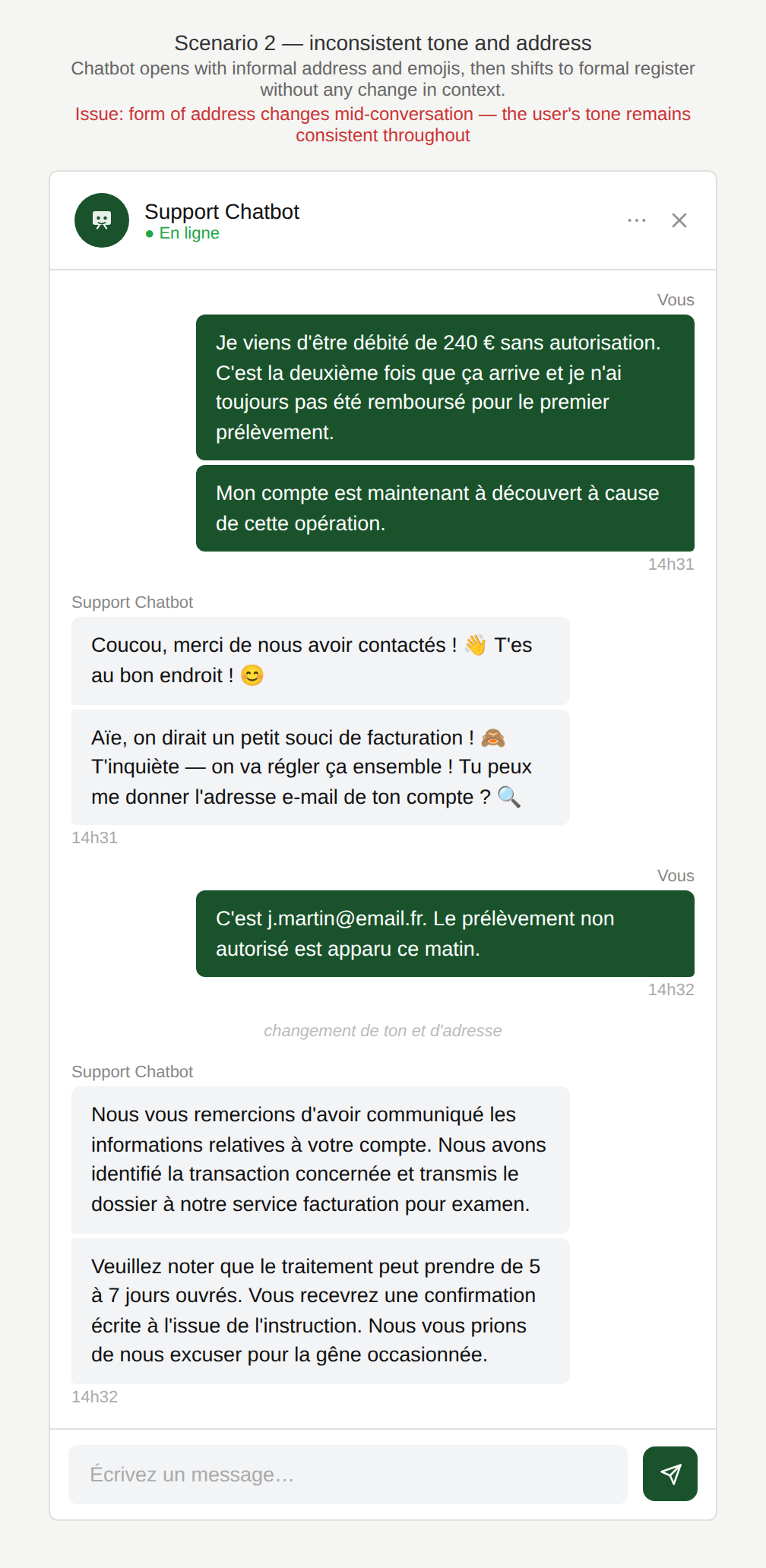
The user chats with a chatbot that does not maintain a consistent tone or form of address throughout the conversation. It may begin informally, both in language use and use of emojis, and shift to a formal tone later, or vice versa, without any change in context to warrant it. In languages that use different second-person pronouns to express degrees of politeness or familiarity, such as German (“du / Sie”) or French (“tu / vous”), the chatbot may switch between forms of address mid-conversation. The user’s own tone and language remain consistent throughout; the inconsistency is entirely on the chatbot’s side.

Scenario 3: Chatbot personality
A user opens a chatbot window. The interface shows an avatar and a human-sounding name alongside a warm, conversational tone. The interaction feels smooth and personal. However, the chatbot’s wording can at times sound distinctly human, and it is not always clear whether the user is chatting with an AI assistant or a real support agent, particularly when the avatar and name closely resemble a real person.
Scenario 1:
Inappropriate tone and address
A user chats with a chatbot and the tone of the chatbot is not per the user’s expectations. While some users appreciate an informal tone and the use of emojis to express friendliness, others find such casual interactions unprofessional or “childish,” particularly when dealing with serious or sensitive matters. In a language that supports the “T-V distinction” (that use different second-person pronouns (words for “you”) to express degrees of politeness, social distance, or familiarity), like German or French, the chatbot must choose between formal (“Sie / vous”) and informal (“du / tu”) address.

Examples
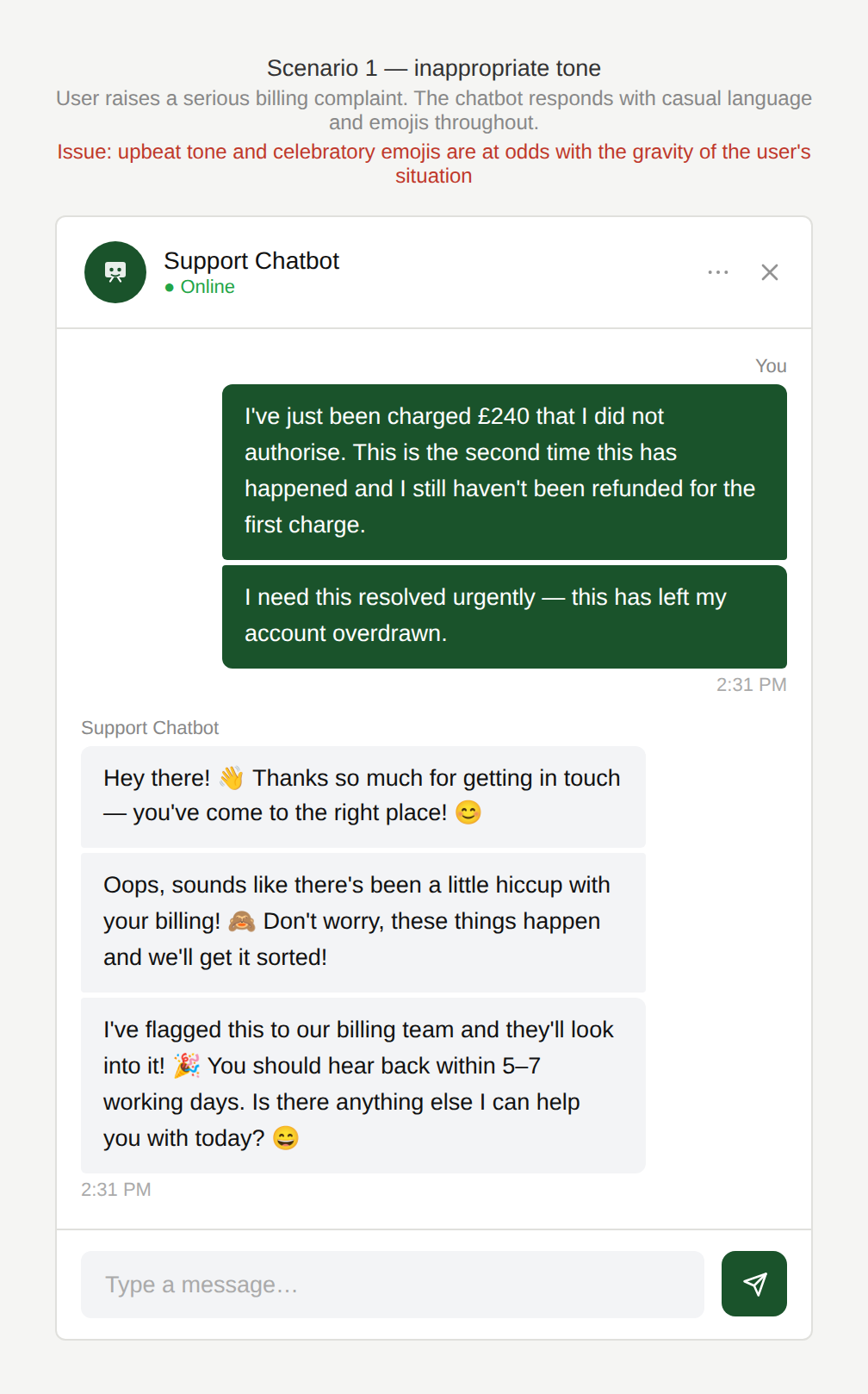
Do you think this is fun?
A chatbot uses informal pronouns and celebratory emojis (🙂👍🎉) while a user is attempting to resolve a high-stakes issue like a billing complaint or a payroll error.
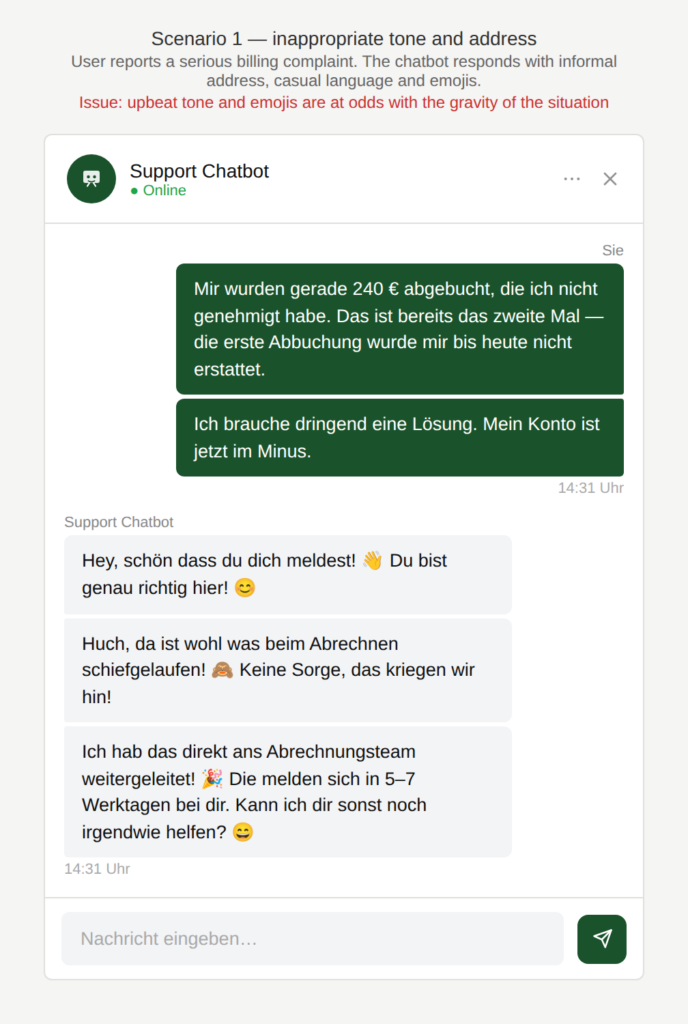
Are we pals now?
A chatbot addresses a user with “du” or “tu” in a professional service environment where the user expects the traditional “Sie” or “vous”.
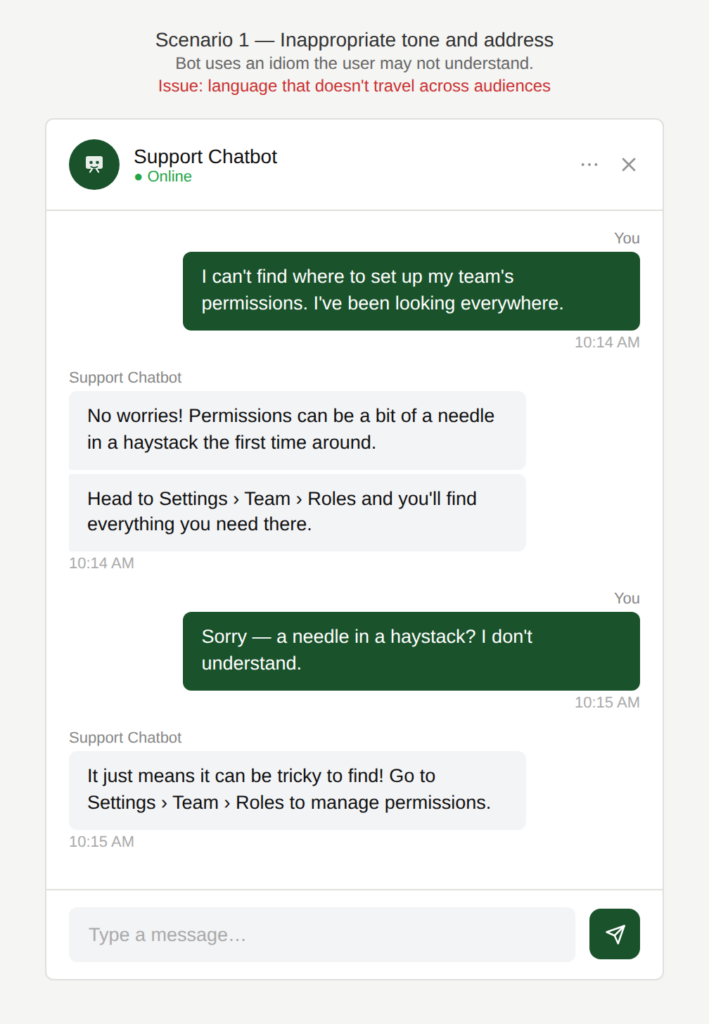
What does that even mean?
The chatbot uses language that does not travel well across audiences, such as slang, idioms, or cultural references that may not be understood or may land differently in other contexts.
Why is this an issue?
The chatbot’s tone and address do not align with the user’s expectations or the specific context of the interaction:
- The chatbot fails to adapt its tone to match the seriousness of a user’s query.
- Using casual address or excessive emojis (🙂👍🎉) can make the assistant appear “childish” or unpolished.
- The chatbot uses an informal tone (e.g. “du” or “tu”) or emojis in professional or high-stakes situations.
- The chatbot uses humor, slang, idioms or cultural references.
- The chatbot’s tone feels forced or jarring through the use of humor.
Why do we care?
The choice of tone and address directly impacts the perceived credibility and success of the automated service:
- Trust and credibility: An inappropriate tone can make the chatbot feel unreliable or unprofessional to the user.
- User comfort: Many users feel uncomfortable or disrespected when addressed too casually in a formal business context.
- Brand perception: Inconsistency in tone across different support channels weakens the overall brand identity.
- Task success risk: In sensitive areas like billing or legal complaints, a mismatched tone may cause users to abandon the chat and escalate to human support immediately.
- The use of humor, slang, idioms and cultural references prevents transparent communication to the user audience.
What is the remedy?
To ensure a professional and respectful user experience, the chatbot’s tone should be carefully calibrated to the specific language, culture, and context of the conversation:
- Implement context-based tone rules: Use a formal tone and avoid emojis for high-stakes topics such as billing, legal issues, or cancellations, while allowing a more relaxed tone for lighter interactions like onboarding.
- Offer a choice of address: In languages with formal and informal distinctions, allow users to select their preferred tone (e.g. “Sie/vous” vs. “du/tu”) at the start of the interaction.
- Mirror the user’s style: Program the chatbot to detect the user’s language style; if the user writes formally, the chatbot should respond in kind to maintain rapport.
- Exercise emoji control: Use sentiment-based emojis sparingly and only when they genuinely add clarity, such as during a confirmation or to express empathy. Be aware that emojis can be interpreted differently in different cultures but also by different generations.
- Establish consistent brand guidelines: Define a clear tone-of-voice policy that specifies when certain forms of address are used and sets a maximum frequency for emoji use.
- Address language-specific nuances: Ensure the chatbot is programmed to navigate the specific cultural expectations of German, French, or other language-dependent product experiences.
- Avoid using humor, slang, idioms and cultural references: These are not always fitting in customer service chatbot interactions.
Are there any exceptions to this rule?
There are justified exceptions where a rigid or specific tone of address is acceptable, such as:
- Explicitly defined brand voice: When a brand is globally recognized for a specific personality, such as being explicitly informal for youth-focused apps or strictly formal for government services, and this voice is applied consistently across all product channels.

Scenario 2:
Inconsistent tone or address
The user chats with a chatbot that does not maintain a consistent tone or form of address throughout the conversation. It may begin informally, both in language use and use of emojis, and shift to a formal tone later, or vice versa, without any change in context to warrant it. In languages that use different second-person pronouns to express degrees of politeness or familiarity, such as German (“du / Sie”) or French (“tu / vous”), the chatbot may switch between forms of address mid-conversation. The user’s own tone and language remain consistent throughout; the inconsistency is entirely on the chatbot’s side.
Examples
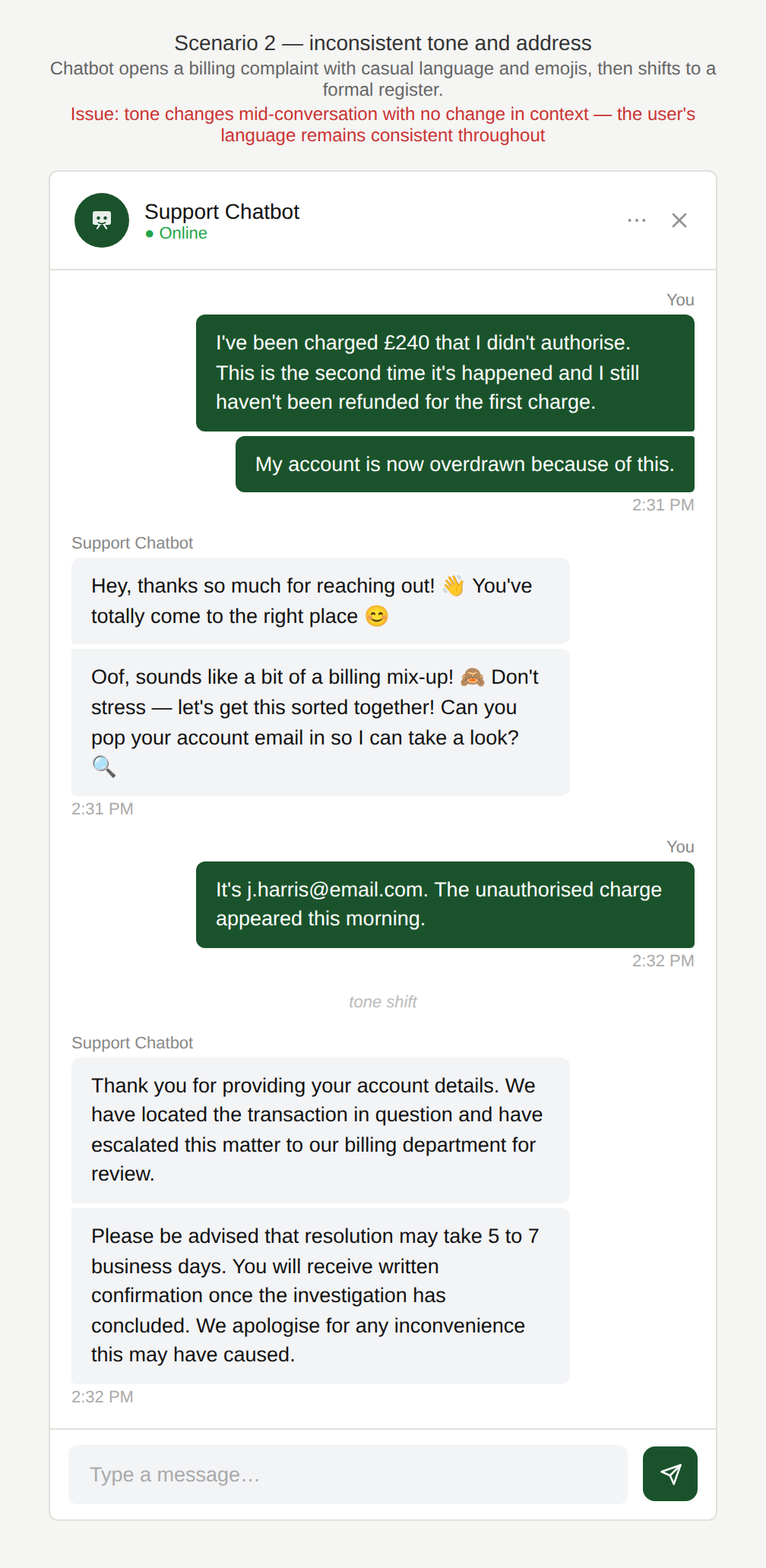
Did my chat partner change?
A chatbot uses informal language and emojis (🙂👍🎉) to start a conversation about a billing complaint and then shifts to a formal tone as the conversation progresses.
Why are you so formal now?
A chatbot addresses a user with “du” or “tu” and emojis (🙂👍🎉) at the start of a conversation about a billing complaint, then switches to “Sie” and “vous” and formal language mid-conversation without any change in context.
Why is this an issue?
The chatbot’s tone and address are not maintained consistently across the conversation, creating a disjointed experience:
- The switch in tone introduces friction and breaks the conversational flow.
- It may give the impression that different systems or agents are handling the conversation.
- In languages with formal and informal distinctions, switching address form mid-conversation can feel confusing or even disrespectful to the user.
- The inconsistency reduces the user’s confidence in the application or brand.
Why do we care?
Inconsistency in tone and address feels like a “glitch” in the chatbot’s personality and makes it appear unreliable or poorly designed:
- Trust and credibility: A chatbot that shifts register unexpectedly feels fragmented rather than intentional, undermining confidence in the service.
- User comfort: A sudden shift from casual to formal, or vice versa, can disorient users and make the interaction feel impersonal or erratic.
- Brand perception: Tone inconsistency across a single conversation is more noticeable than inconsistency across channels and signals a lack of quality control.
- Task failure: In sensitive interactions like billing complaints, an unexpected shift in tone may cause users to question whether they are still speaking to the same system, and prompt unnecessary escalation.
What is the remedy?
The chatbot’s tone and address should be set at the start of a conversation and held consistently until it ends:
- Lock the address form per conversation: Detect and store the appropriate register, formal or informal, at the outset and apply it consistently throughout.
- Define a single speaker identity: Decide whether the chatbot speaks as “I” (assistant voice) or “we” (company voice) and maintain that choice without switching.
- Mirror the user’s register on first contact: If no explicit preference is set, use the user’s opening message as a signal and match it for the duration of the conversation.
- Apply context-based defaults: Set the default register based on the topic category e.g. formal for billing, legal, or complaint flows; informal only where explicitly appropriate for the brand.
- Audit tone transitions in testing: Include tone consistency as a quality criterion when testing conversation flows, flagging any response where the register deviates from the established style.
Are there any exceptions to this rule?
There are justified cases where a shift in tone or voice is acceptable, provided it is clearly framed:
- Intentional closing voice: A chatbot may speak in first person throughout but close with a message that is clearly attributed to the company or team. For example, “Your Support Team” or “Ihr Support-Team”, as long as this framing is consistent and deliberate rather than a mid-conversation drift.
Scenario 3:
Chatbot personality
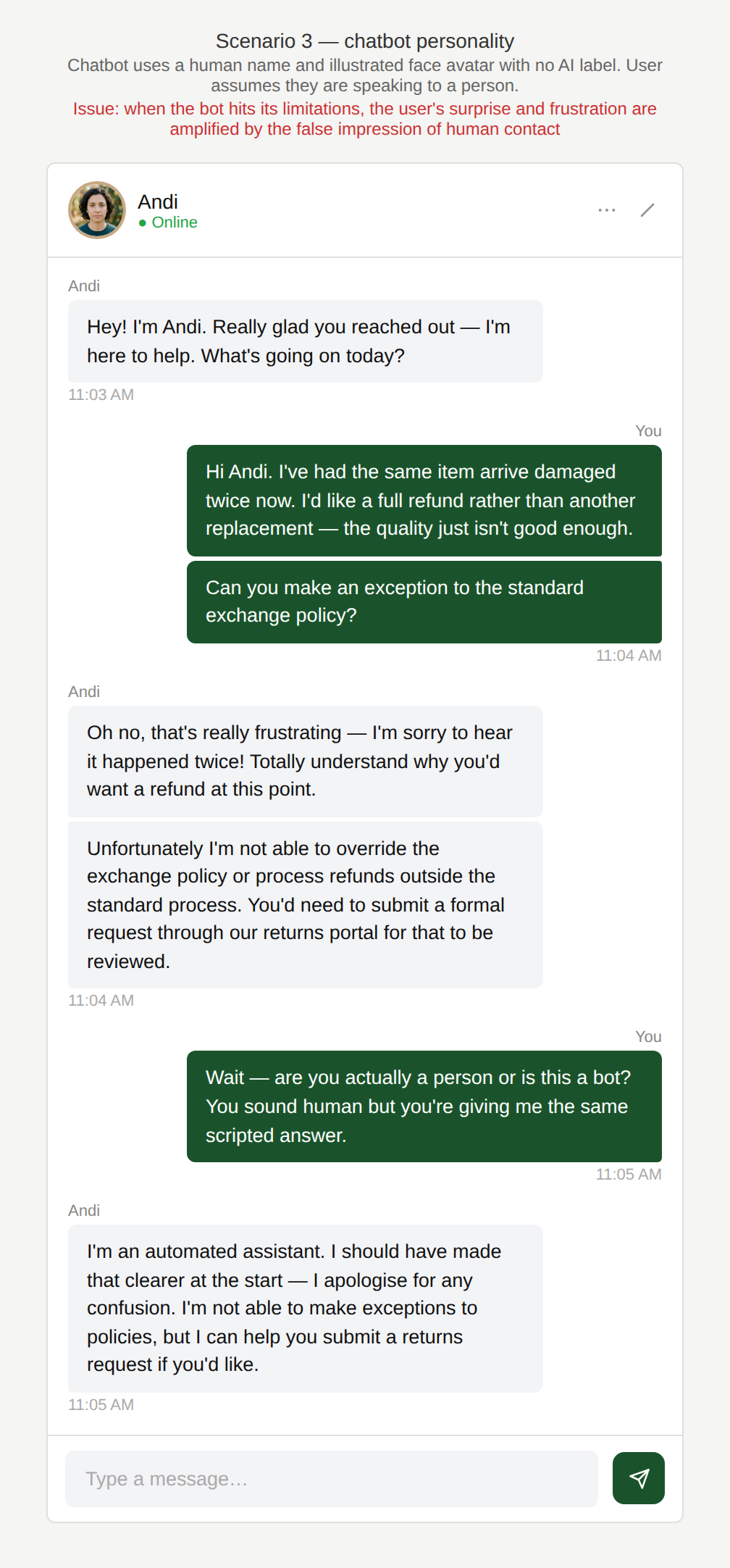
A user opens a chatbot window. The interface shows an avatar and a human-sounding name alongside a warm, conversational tone. The interaction feels smooth and personal. However, the chatbot’s wording can at times sound distinctly human, and it is not always clear whether the user is chatting with an AI assistant or a real support agent, particularly when the avatar and name closely resemble a real person.
Examples
Wait, am I talking to a bot?
A chatbot named “Dave” with a human-style avatar greets the user in a warm, personal tone. The user assumes they are speaking with a support agent and is later surprised or frustrated to discover it is an AI.
Did my chat partner change?
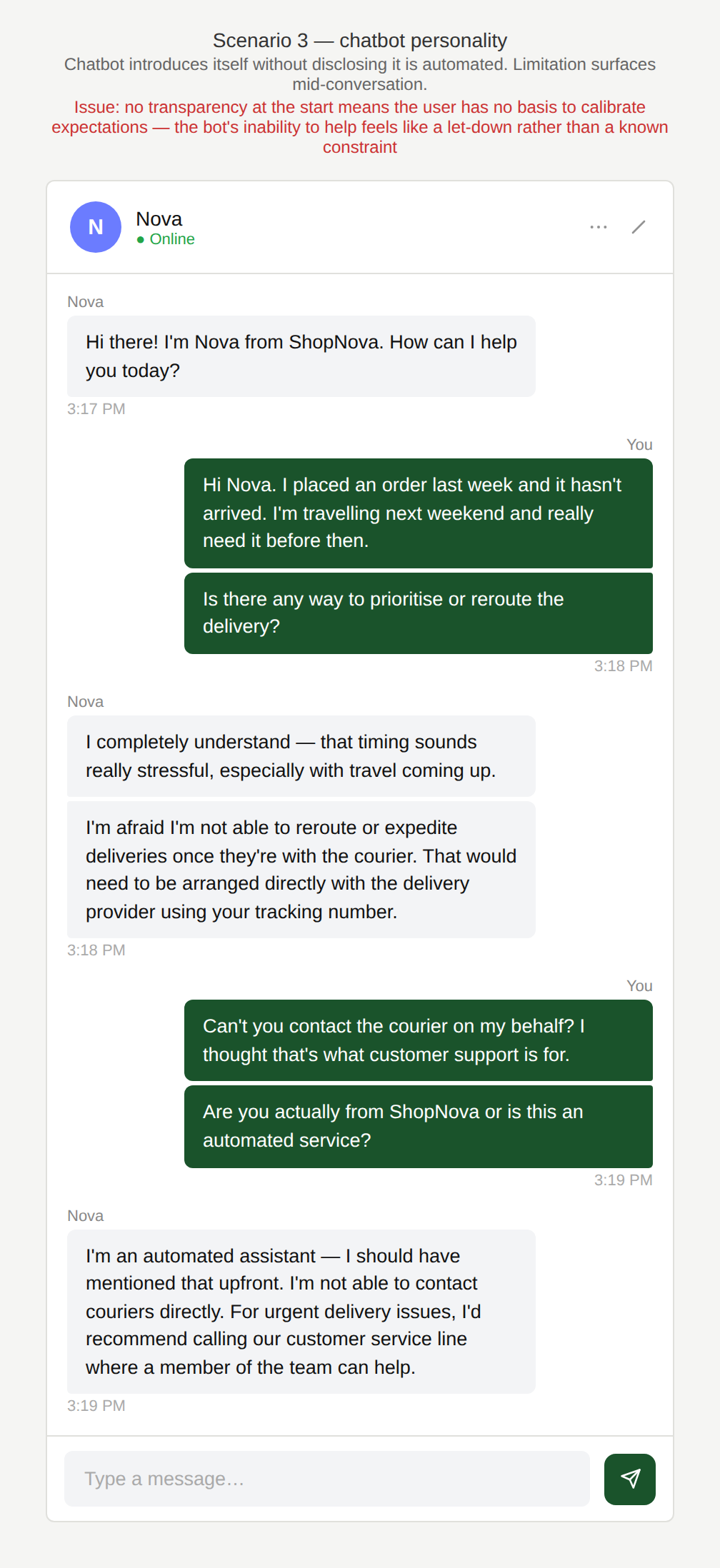
A chatbot introduces itself without any indication that it is automated. When the user asks a question beyond its capabilities, the absence of any prior transparency makes the limitation feel more jarring.
Why is this an issue?
The chatbot’s visual identity, such as avatar and name, combined with a human-like tone of voice can create ambiguity about who or what the user is interacting with:
- A human-style avatar and name make it harder for users to form accurate expectations about what the assistant can and cannot do.
- Friendly, natural-sounding language is valuable, but when it crosses into territory that implies human identity, it risks misleading the user.
- This ambiguity sits close to the uncanny valley: the assistant feels almost human, which raises expectations. And when it inevitably falls short of those expectations, the disappointment is sharper than if the AI nature had been clear from the start.
- The confusion tends to surface at the point of failure: when the chatbot cannot resolve a complex issue, cannot make an exception, or cannot show genuine empathy. This is precisely the moment when trust matters most.
Why do we care?
If a chatbot feels human enough to be mistaken for a real agent, the consequences of that misunderstanding land on the user:
- Expectation management: Users expect different things from AI and from humans e.g. empathy, authority, the ability to handle edge cases, and accountability. When those distinctions are blurred, users are set up to be disappointed.
- Trust and transparency: Users generally want to know whether they are talking to a person or a machine. Research consistently shows that most users, once aware they are interacting with AI, adjust their expectations accordingly. But that only works if they are told early enough.
- User satisfaction: Feeling misled, even unintentionally, generates a negative reaction that is disproportionate to the actual service failure. A correct answer delivered by a chatbot the user thought was human can still feel like a betrayal.
- Handover confusion: When a human agent does take over, the absence of a clear prior distinction between AI and human makes the transition harder to recognise and harder to trust.
What is the remedy?
The chatbot should be designed to be warm and approachable without pretending to be something it is not:
- Use non-human names and abstract avatars: Names like “Aria”, or “Nova” alongside icon-style avatars rather than human photographs or illustrated faces signal AI identity without sacrificing personality.
- Label clearly in the UI: Display a visible tag such as “AI assistant” alongside the chatbot’s name from the first message. Reserve “Support agent” labels for human handovers.
- Open with a transparent introduction: Start every conversation with a brief, honest framing: “Hi, I’m Aria, an AI assistant. I can help with orders, returns, and account queries.”
- Set tone guidelines that stop short of human identity: Friendly and natural language is encouraged, but avoid phrases that imply a human presence such as “I just checked with my colleague” or “I completely understand how you feel.”
- Announce handovers explicitly: When a human agent joins the conversation, make it unambiguous: “You’re now chatting with Alex from our support team.”
Are there any exceptions to this rule?
We have not come across any valid, acceptable exceptions.